Refer a Patient





Do you also enjoy vaping or think it to be a safer nicotine replacement for cigarettes? Think twice. The biggest misconception about vaping is that it’s safer than smoking a cigarette or other forms of nicotine.
The National Institutes of Health states that vaping or any equivalent form of electronic e-cigarettes is directly tied with tooth decay and long-term effects, including changes in salivatory glands.
Numbers Don’t Lie
Don’t take our word; see what the officials have to say. The Canadian Tobacco and Nicotine Survey conducted in 2022 for the youngsters aged 15 and older found the below:
- 6% of Canadians aged 15 and older had reported vaping, with 14% of them aged between 15 and 19.
- Vaping to reduce stress was reported as the main reason for vaping among 15-19-year-olds (31%). Almost 44% of those aged 25 and older said they vape to reduce, quit, or avoid returning to smoking.
- Around 7% of people who vaped were males, and 5% were females.
The numbers are more alarming when it comes to children in grades 7-12. Almost 17% of these students said they used e-cigarettes within the last 30 days.
What Are Vapes or E-Cigarettes
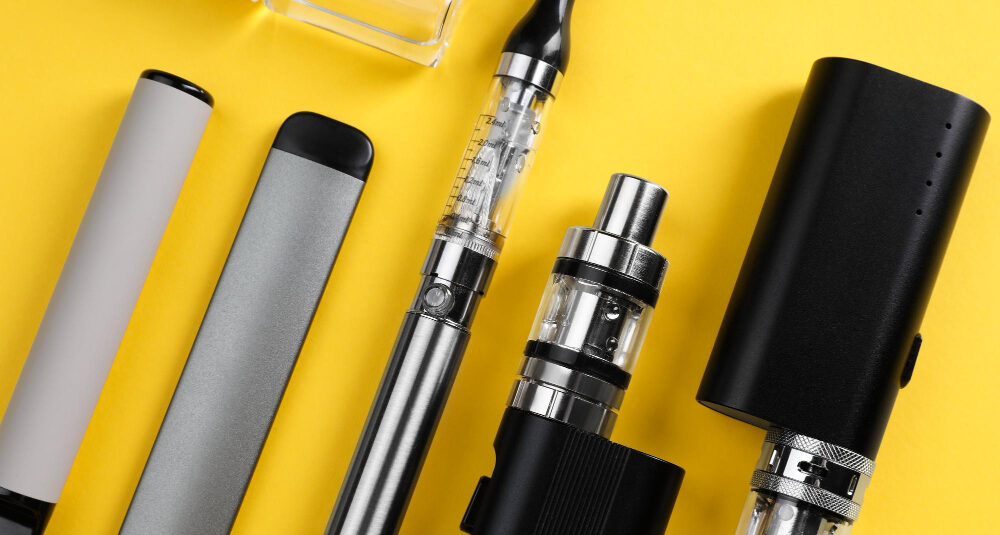
Officially classified as e-cigarettes, vapes use a certain heating element inside a casing to vaporize the liquid—also known as “e-juice.” The liquid inside the vape isn’t water or harmless liquid, as many claim. It contains nicotine, and sometimes even cannabis is used in its formulation.
According to a study, the content of nicotine has drastically increased from 1.7% to 5%. This is double the amount of nicotine contained in cigarettes.
The Myth: “It’s Just Water Vapor”
Vape aerosol isn’t water vapour – it’s a heated mix of propylene glycol, vegetable glycerin, flavoring chemicals, and (in most products) nicotine. Health Canada and Canadian researchers are clear that while vaping may expose users to fewer harmful substances than burning tobacco, it is not considered safe, particularly for people who weren’t already smokers. (Statistics Canada)
That “less harmful than smoking” framing has a lot of marketing behind it — but it’s a relative claim, not a safety claim. And when it comes to oral health specifically, the line between vaping and smoking is a lot thinner than most people assume.
What Vaping Does Inside Your Mouth
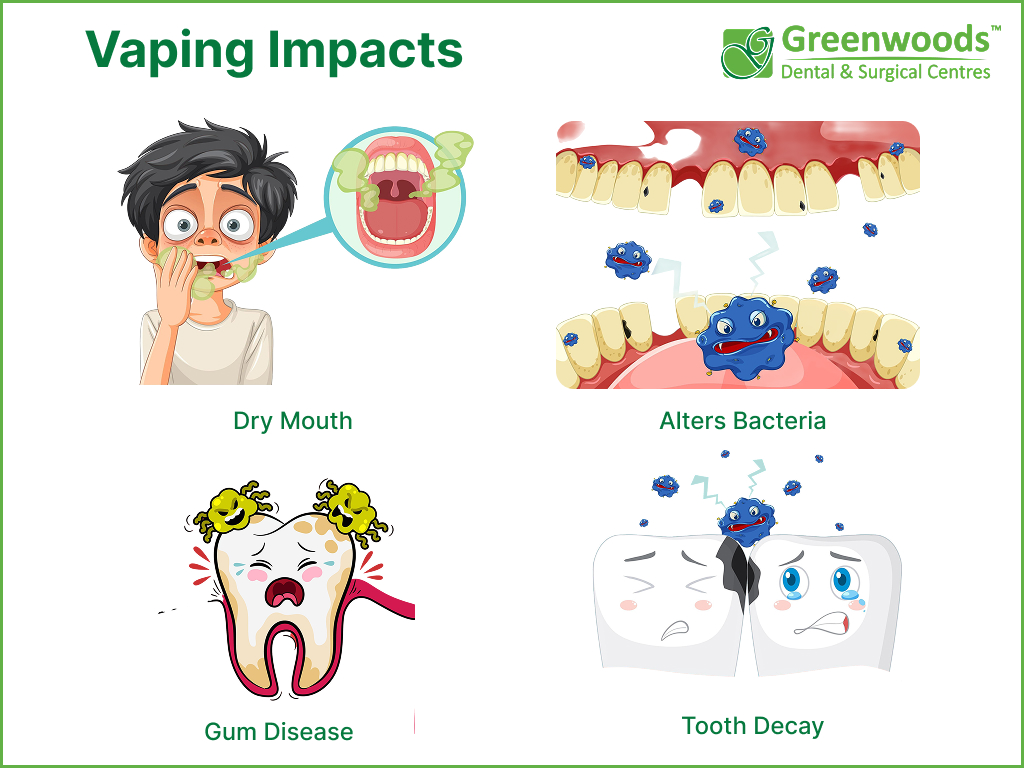
1. It dries your mouth out – and that’s a bigger deal than it sounds
Propylene glycol, the main ingredient in most e-liquids, is hygroscopic – it actively pulls moisture out of oral tissue. Combine that with nicotine (which further reduces saliva flow) and the heat of the vapor itself, and the result is a taste-altering dry mouth. (Delta Dental of Washington; AAO)
This matters because saliva isn’t just for comfort – it’s your mouth’s built-in defense system. It washes away bacteria and neutralizes acid. Without enough saliva, food debris sticks around longer, plaque builds up faster, and cavity risk climbs.
2. It changes the bacteria living in your mouth
Vaping excessively alters the state of bacteria that live inside your mouth. A recent study at NYU Dentistry – a first of it’s kind – tracks e-cigarette users’ oral health over time – found that vapers develop a microbiome inside their mouth, which worsens over time.
The same study also states that all participants who smoked vape had some form of gum disease, which only worsened in some participants after six months.
3. Increase in gum disease
A staggering 43% of people who use e-cigarettes or vapes had gum disease and oral infections, according to the iScience journal. Meanwhile, the percentage of people with gum disease who never smoked or vaped was far less at 28%.
The same journal further mentions that vaping stresses your oral bacteria and changes them by encasing bacteria in a slime. Basically, it’s like killing your good bacteria and allowing yourself to expose to diseases.
4. The sweet e-juice
Apple, peach, kiwi and mint! Most vapers are addicted to their signature flavors, but what they do not know is that sweet juice is the major contributor to tooth decay. The flavoring agents inside the liquid can eat away the tooth enamel, exposing your healthy tooth to various bad bacteria. Combine this with dry mouth, and you have the perfect recipe for cavities.
“But It’s Better Than Smoking, Right?”
For lung and cancer risk specifically, most public health bodies agree vaping likely carries lower risk than combustible cigarettes. But oral health doesn’t follow that same pattern as cleanly.
Multiple studies place e-cigarette users’ gum health between smokers and non-smokers—meaningfully worse than people who use neither product, even if not quite as severe as traditional smoking. (News-Medical, Evidence-Based Dentistry systematic review)
And on a few specific fronts, vaping introduces problems traditional cigarettes don’t. Propylene glycol found in vape liquid but not in tobacco smoke — is a direct contributor to dry mouth, meaning vapers face a decay risk pathway that smokers don’t experience in the same way. Even nicotine-free vape liquids aren’t off the hook: the base ingredients themselves can still irritate oral tissue and dry out the mouth.
The Canadian Picture
This isn’t an exclusive issue for Canadian dentists – it’s a demographic shift happening in the chair. Canada has some of the highest youth vaping rates in the world, with national survey data showing roughly 17% of students vaping in the past month, and daily vaping rates among grades 10–12 among the highest ever reported globally. (CBC News)
That means dentists are increasingly seeing early signs of vaping-related oral changes – dry mouth, gum inflammation, early decay — in younger patients who would never have shown these signs from smoking at the same age, since cigarette use among teens has historically been far lower.
Warning Signs Worth Bringing Up at Your Next Visit
If you vape, keep an eye out for:
- Persistent dry mouth or thirst, especially after vaping sessions
- Bad breath that doesn’t improve with brushing
- Gums that bleed easily or look red and puffy
- New tooth sensitivity
- Mouth sores or patches that don’t heal within two weeks
- Slower healing after dental cleanings or procedures
None of these mean panic — but they’re exactly the kind of early signals that are much easier to manage before they progress into gum disease or cavities.
TL;DR
“Safer than smoking” isn’t the same thing as “safe.” Vaping introduces its own distinct set of risks: chronic dry mouth, a disrupted oral microbiome, elevated gum disease markers, and cavity risk that doesn’t require any actual sugar to develop. The research is still relatively new, but it’s already consistent enough that dental and medical organizations are treating it seriously rather than dismissing it as a non-issue.
If you vape, that’s not something you need to hide from your dentist—being upfront about it just means we can watch for the right things and catch problems early, before they turn into something bigger.
Noticing dry mouth, gum irritation, or sensitivity? Let’s take a look before it progresses. Book an appointment or call 1-866-774-0006. Our team at Greenwoods Dental will expertly assess your oral health needs and suggest a treatment plan.